01
Nothing is uploaded
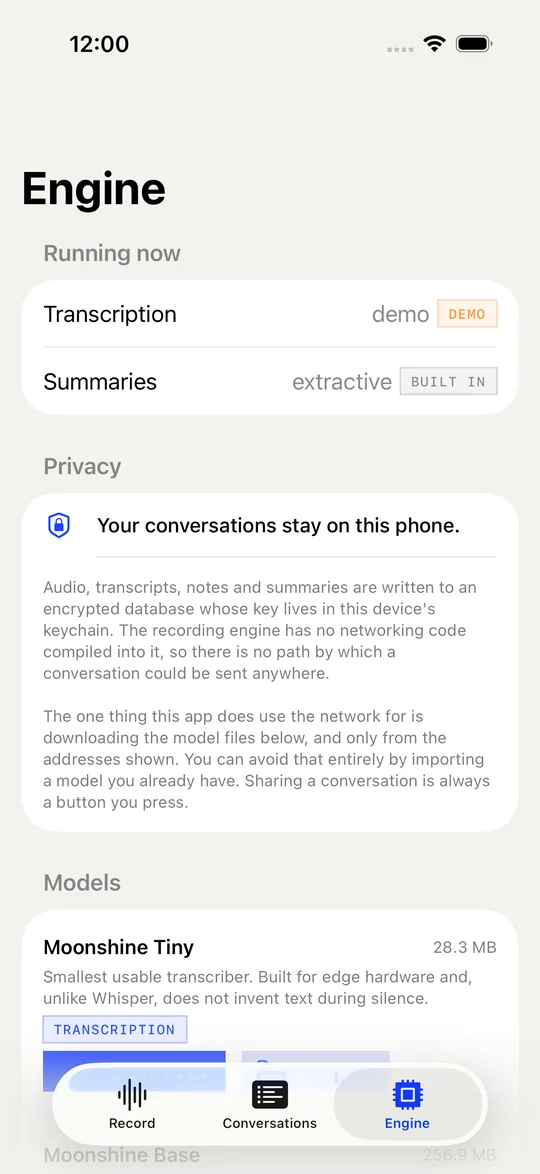
Transcription and summarisation run on the phone. The recording engine has no HTTP client compiled into it, so there is no code path by which a conversation could be sent anywhere.
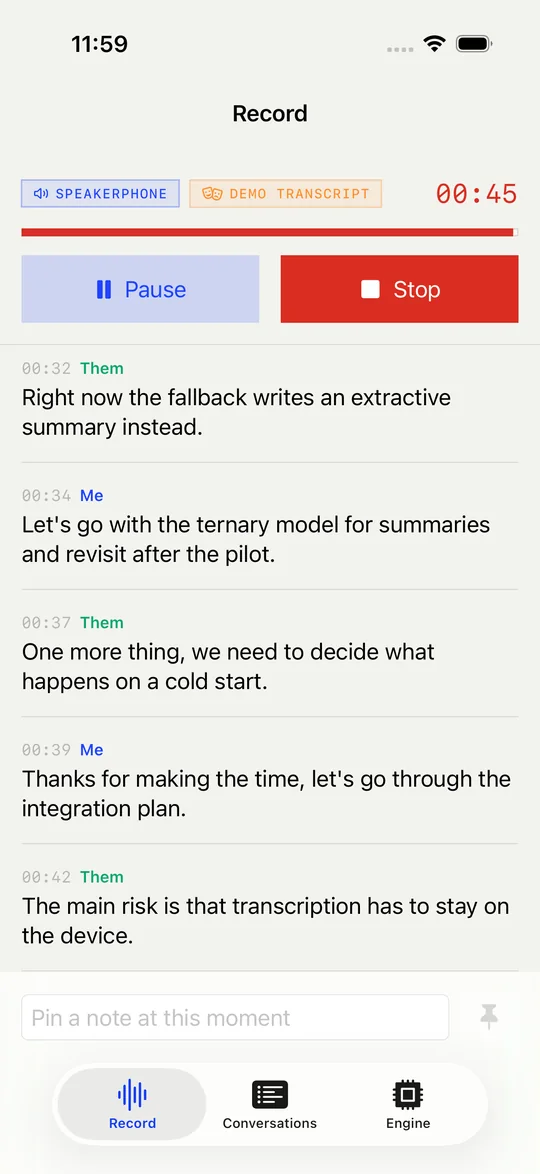
Brink Debrief records a conversation, timestamps every line, pins your notes at the moment you took them, and writes the summary — with every model running on the phone. Nothing is uploaded. There is no subscription.
Built on Brink Compute — the same edge engine, in our own product.
Almost every tool in this category uploads the audio, transcribes it on a server and bills you monthly for the privilege. That is a reasonable trade for some conversations. It is the wrong trade for a salary review, a diagnosis, a term sheet, or a source who agreed to talk to you and not to a vendor.
Transcription and summarisation run on the phone. The recording engine has no HTTP client compiled into it, so there is no code path by which a conversation could be sent anywhere.
Everything lands in a SQLCipher database whose 256-bit key is held by the iOS Keychain or wrapped by a non-exportable Android Keystore key — never stored beside the data it protects.
A basement meeting room, a flight, a client site with guest wifi you would rather not join. The models are already on the device, so none of it matters.
There is no server to pay for, so there is no per-minute meter. Download the models once and the app keeps working whether or not anyone is still selling it.
Notes you pin land in the timeline at the moment you took them, not in a separate list you have to reconcile later. Speaker labels are honest: the app says unknown rather than guessing.
iOS exposes no way to tap the other person’s audio, and during a call the telephony stack owns the microphone outright. Android gates the same thing behind a permission no app on the store can hold. The earbuds that manage it do the recording in firmware, on the far side of that boundary — not in their app. Anyone telling you otherwise is describing hardware, or is wrong.
So: put the call on speaker and Brink Debrief gets both voices, because the other person is genuinely audible in the room. Wear a headset and it gets you. The app knows which of these happened and says so on the recording, rather than letting you find out later that half the conversation was never there.
Audio from the phone mic, a Bluetooth headset or the loudspeaker, normalised to 16 kHz mono whatever the hardware hands over.
A voice detector with a noise floor that adapts to the room decides what is speech, so the expensive stage only ever sees words.
Moonshine turns each utterance into text on the device, and every line is stamped against the wall clock.
Two-cluster speaker attribution separates you from them by pitch. It never claims an identity, and answers “unknown” when the evidence is thin.
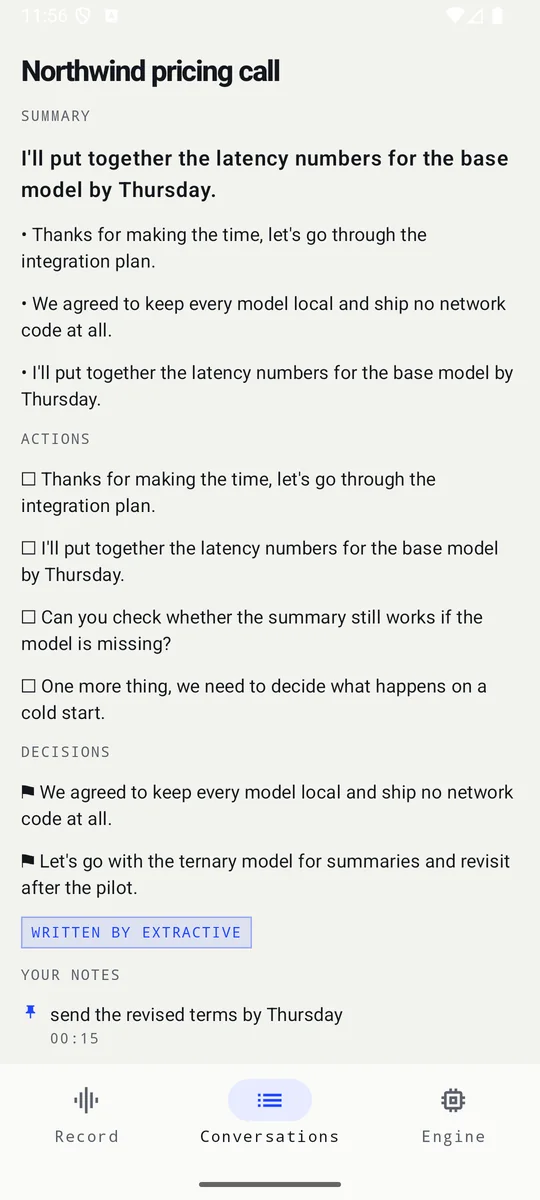
Bonsai writes the headline, the bullets, the action items and the decisions. The app always names the engine that wrote them.
Speaker attribution answers me, them or unknown — and it really does return unknown when two voices are too alike or there has not been enough speech yet. It is a two-cluster problem by design, because the only question you ever ask of a transcript is which side said it. It never claims to know a name.
Downloading the weights is the only thing the app ever uses the network for, and only from the addresses it shows you. If you would rather it never made a request at all, import the files yourself and it never will.
Matches far larger models on English, and unlike Whisper it does not invent text during silence.
Ternary weights — every weight is −1, 0 or 1, which is what keeps half a billion parameters inside a phone's memory budget.
With no model installed the app still records, timestamps, pins your notes and writes an extractive summary with no weights at all — and it always names the engine that wrote it, so you are never guessing which one you are reading.
iOS and Android. Tell us what you record and we will get you in early.